Tuesday, November 05, 2013

All your favourite brands belong to just 10 companies


You’ve probably seen this graphic doing the rounds on social media already. But if not, it really is well worth a look. It’s called ‘The Illusion of Choice’. You see lots of brands on the supermarket shelf and you get to choose your preference – maybe you choose on price, quality, smell, taste, perceived value and more. But how much of a choice is it when those brands all belong to the same companies?

You might wonder why I think this is worthy of note. Well, I think it’s worth being mindful of what you buy and where that money is going. I didn’t know that Nestle owned L’Oreal who in turn owns The Body Shop, Stella McCartney and Kiehl’s. It’s made me think again about Kiehl’s as a brand and makes me question their product quality. And can Diesel maintain its (relatively) cool brand image when its parent company is Nestle?

Equally, I think it’s important to understand how these brands and companies do deals with each other in their own company group. One example cited is Yum Brands which owns KFC and Taco Bell. The company was a spin-off of Pepsi. All Yum Brands restaurants sell only Pepsi products because of a lifetime deal with the soda-maker. Not a lot of choice going on there.

I’m not saying don’t buy these brands, maybe just be a little more mindful each time you do.

Source: technokitten

Wednesday, August 01, 2012

Attention, U.S. startups: Don’t ignore China

Startups should have a China strategy.

It’s that simple.

Thanks to the sheer buying power in China, what happens in China will increasingly impact the United States and other markets around the world.

Unfortunately, the evolution of a U.S. startup typically goes something like this:

  • Create proof of concept
  • Get money
  • Build the product
  • Market the product in the United States
  • Get more money
  • Solidify and/or diversify product offering
  • Start scaling in the United States
  • Get more money
  • Explore global markets

As result, startups don’t start thinking about China and the global scene until a good two years or more into their life cycle, when they should be thinking about China right from the get go.

This doesn’t mean you need to buy Rosetta Stone for Mandarin or uproot your entire company for a move to China. It doesn’t even mean opening a small satellite office in China.

Instead, it means taking the time to study your space in China. Who are the players? Who’s winning? Why?

This way, you can intelligently factor China into your long-term strategy.

The Activision Experiment

While Activision isn’t a new venture, it’s still revealing to look at its recent experiment in China.

The company has taken the Call of Duty franchise and dropped around $50 million to create a version tailored for the China market. But the pricing model is where things get interesting.

While U.S. consumers spend up to 60 bucks for the latest installment of Call of Duty, the version for China will go for substantially less.

Try zero.

They’re literally giving away the game.

Games consoles like the Xbox generally dominate PC gaming. Not so in China, where consoles take a backseat to PC gaming thanks to the McDonald’s-like presence of Internet cafes. Activision figures revenue will come from selling the add-ons – Need a better bazooka? Done with a few Renminbi – that help players perform in the game.

Yet the move by Activision isn’t just about China. This is a global play.

Shrinking Home-field Advantage

The biggest market for the vast majority of tech products has been the United States.

Unfortunately, the Bill of Rights does not guarantee life, liberty and the pursuit of home-field advantage. The reality is that the mantle of the single largest concentration of tech buying power is migrating to China.

The crossover in mobile phone units has already occurred, with China being the first country to tip 1 billion mobile subscribers, and it’s only a matter of time before the revenue follows suit.

Even if it doesn’t make sense for your company to establish an office in China, you still need to anticipate how China’s ripple effect will impact your global opportunity.

Our China Journey

We embarked on our China homework in 1996 and ended up planting our flag in Beijing in 1999. I remember sharing with the Silicon Valley team that we couldn’t be a strong company in Asia unless we were strong in China.

I no longer believe this.

I now think being relevant on a global basis requires strength in China.

Regardless of expansion plans, you should make a point of periodically traveling to China. Talk to people. See what’s going on. It’s only by being on the ground and absorbing the scene through osmosis that you can start gaining a feel for the market.

Physically being in China also accelerates the relationship-building. If you don’t start building your network of contacts in China now, by the time you need them, it’s too late.

I can speak from first-hand experience that trips to China aren’t combat duty (although the flights in United coach come close). Even after making countless trips through the years, I learn something every time I’m in Shanghai or Beijing.

That’s precisely the point.

The success or failure for any startup largely comes down to the learning curve.

And China should be part of your curriculum.

China Resources

Here are six resources with the potential to accelerate your China learning curve:

  • China Chamber of Commerce: One of the best ways to network in the Chinese business community. The website offers a decent range of information such as the Small Biz Handbookwhich gets into the mechanics of starting an operation in China.
  • U.S.-China Business Council: If your space deals with telecommunications, media, IP or other areas guided by government regulations, this is a good organization to join. The cost is based on number of employees, so it’s actually fairly cost-effective for a new venture ($2,750 for less than 10 professionals).
  • HYSTA (Hua Yuan Science and Technology Association): The organization serves as an advocate for connecting Silicon Valley and China. Their annual conference takes place on September 29, 2012 at the Hyatt Regency in Santa Clara and is open to everyone. It’s a perfect way to jumpstart your China knowledge (Disclosure: We support HYSTA on a pro-bono basis).
  • Foreign Entrepreneurs in China: Clara Muriel Ruano nicely captures the entrepreneurial scene in China as a generalist, not technologist (her background is in packaged goods). Clara is originally from Spain, so it can be refreshing to hear a non-American voice.
  • Image Thief: Will Moss, director of communications for Motorola’s mobility biz in Asia, moved to Beijing in 2004. Don’t be fooled by the title. His posts reveal the day-to-day texture of living, working, and breathing – air quality can be controversial thanks to tweets from the U.S. embassy – in China.
  • The China Law Blog: If you’re thinking the legal system in China is another world, you’re right. This blog covers legal issues with a pragmatic business undercurrent.

Lou Hoffman is CEO of The Hoffman Agency, a communications consultancy focused on the tech sector with offices in Asia, Europe, and Silicon Valley. He made his first trip to China in 1998 before opening the firm’s office in Beijing. He blogs on storytelling through a business prism atIshmael’s Corner and can be found on Twitter at @LouHoffman.

Article Source: VentureBeat

Image Source: testing / Shutterstock.com

Posted via email from Technobedouin

Friday, October 14, 2011

Social Media Report: Spending Time, Money and Going Mobile

Social media not only connects consumers with each other, but also with just about every place they go and everything they watch and buy. Nielsen’s new Social Media Report looks at trends and consumption patterns across social media platforms in the U.S. and other major markets, exploring the rising influence of social media on consumer behavior.

Highlights of Nielsen’s “State of the Media: The Social Media Report”

  • Social networks and blogs continue to dominate Americans’ time online, now accounting for nearly a quarter of total time spent on the Internet
  • At over 53 billion total minutes during May 2011, Americans spend more time on Facebook than they do on any other website
  • Tumblr is an emerging player in social media, nearly tripling its audience from a year ago
  • Nearly 40 percent of social media users access social media content from their mobile phone
  • Internet users over the age of 55 are driving the growth of social networking through the Mobile Internet
  • 70 percent of active online adult social networkers shop online, 12 percent more likely than the average adult Internet user
  • Across a sample of 10 global markets, social networks and blogs are the top online destination in each country, accounting for the majority of time spent online and reaching at least 60 percent of active Internet users

aud chart for social media report wire post

For a more in-depth look at the social media landscape and audience, view the complete State of the Media: The Social Media Report

Source: Nielsen Wire

Posted via email from Technobedouin

Thursday, July 21, 2011

The Rise of Mobile In-App Ads [INFOGRAPHIC]

11

If mobile apps are all the rage, then mobile in-app ads are causing rage.

In one recent example, the popular franchise Angry Birds saw in-app ads added to its HD version, and fans and players were in an uproarover the change.

But like them or not, mobile marketers are turning more attention toward in-app advertising. Right now, in-app ads account for around 5% of mobile ad spending, and that number is only expected to rise over the next few years.

One of the reasons in-app ads are taking off is their effectiveness. In spite of the fact that the majority of 18-34-year-olds actively dislike mobile in-app ads, the majority will also be able to recall those ads at a higher rate than the ads they see while browsing the mobile web.

And for app makers, the ads are a good bet, too. After all, Angry Birds publisher Rovio says that by the end of 2011, it’ll be making $1 million each month from in-app ads on the Android platform alone.

While we’re hoping to see better in-app ads as the ecosystem becomes more sophisticated, it’s interesting to monitor in-app ads in today’s relatively nascent state. 

Article source: Mashable

Image courtesy of iStockphotoDougSchneiderPhoto

Posted via email from Technobedouin

Tuesday, May 31, 2011

Study Reveals Why Consumers Fan Facebook Pages

Have you ever wondered why people decide to become fans of Facebook pages?  Understanding the reasons people become fans can help your business or brand develop better strategies.

In this article, I take a look at two studies.

The first reveals why consumers fan businesses on Facebook. The second one examines how marketers are keeping up with the ever-changing world of social media. 

#1: Nearly 40% of Consumers “Like” Companies on Facebook to Publicly Display Their Brand Affiliation to Friends

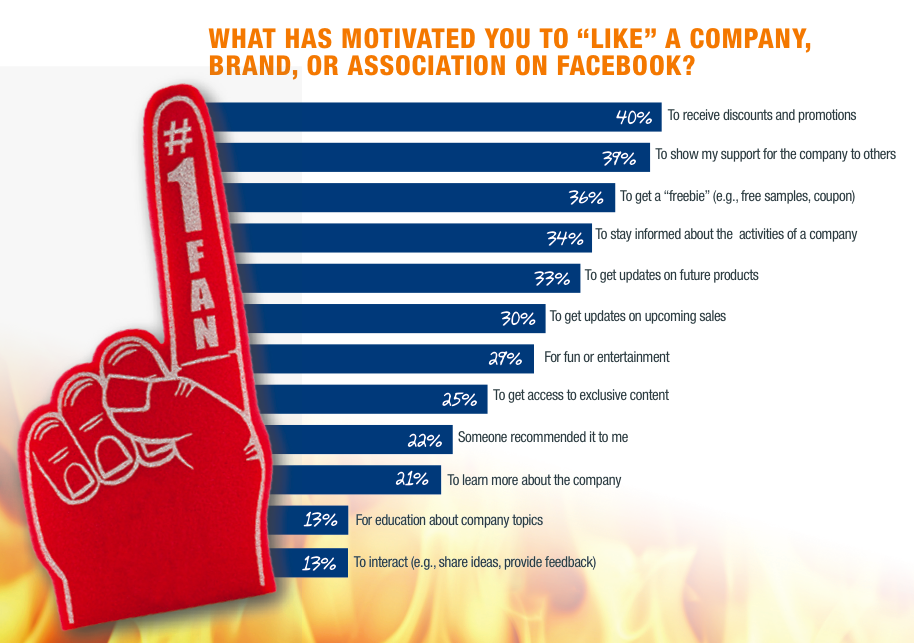
As Facebook grows, we’re able to learn even more about the behaviors and preferences of its users. As Facebook continues to change, new stats surface to give us an even better idea of how consumers on Facebook prefer to interact with brands and companies. A new report released by ExactTarget and CoTweet found that discounts and “social badging” were the primary reasons consumers Like brands on Facebook.

Nearly 40% of Facebook users who become fans do so to receive discounts and promotions and 39% become fans to show their support for a brand to their friends. Just as interesting is how these stats compare to Twitter and email marketing. Only 23% of respondents said they follow brands on Twitter and about 10% say they subscribe to email notifications for the same reasons.

Here are some other interesting facts from the report:
  • 43% of the Facebook users surveyed said they Like, or are fans of, at least one brand on Facebook.
  • 34% of Facebook users say they Like brands in order to stay informed about company activities.
  • 33% say they Like brands to get updates on future products.
  • Among Facebook users who Like at least one brand, only 17% say they’re more likely to buy after Liking that brand on Facebook.
“Consumers use Facebook to interact with friends, be entertained and express themselves through their public affiliation with brands—factors that combine to create a potent viral marketing platform,” said Jeff Rohrs, principal, ExactTarget’s research and education group. “By engaging consumers on Facebook in a way that keeps them entertained, brands have an unprecedented opportunity to mobilize Fans and get introduced to their friends.”

#2: Marketers Are Challenged to Stay Up-to-Date on the Latest Social Media Developments

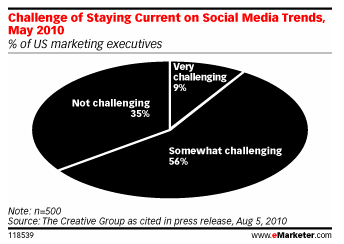
It’s no surprise that marketers are struggling to stay current with the constantly fluctuating social media trends. In a recent survey by The Creative Group, 65% of U.S. marketing executives considered it at least somewhat challenging to keep up.

The graph above shows the breakdown of how challenging respondents viewed staying current with social media trends.

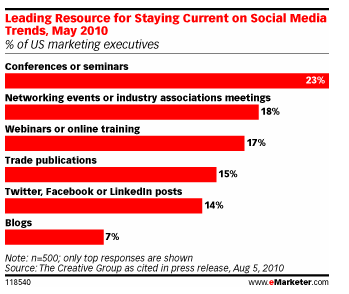
In addition, 23% of respondents cited the best resource for staying up-to-speed on social media is conferences or seminars. Surprisingly, and coming in second at 18%, was attending networking events or industry association meetings.
Only 14% cited Twitter, Facebook and LinkedIn posts as their resource of choice for staying current, while a low 7% cited blog posts as their main resource.

The chart above shows the leading resources marketers cited for staying current with social media trends. Notice how social media sites were less popular than in-person events as key resources.

“Networking becomes even more important during periods of rapid change,” said Donna Farrugia, executive director of The Creative Group. “Many marketers are aware of broad social media trends, but they need nuts-and-bolts information on how to most effectively use new channels. That’s where insight from peers on what worked and did not work for them can be most valuable.”

By Amy Porterfield

Posted via email from Technobedouin
Monday, April 11, 2011

AdMob survey data on Tablet usage released

Key points of report:

  1. Most important trend was that tablets are replacing time spent with PCs. 43% of respondents said that they're spending more time with their tablet than their PCs now.
  2. People are spending ~1 hr/day on their tablet, mostly at home and on weekday nights. This has implications for campaign management / optimization.
  3. Tablets are most often used for games, searching for information & email.
Tablet games
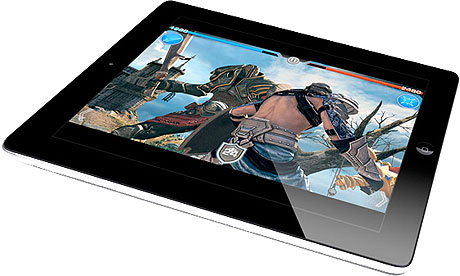
US tablet owners use the devices mainly for games, says a Google survey

Google survey finds games trump all other uses for tablets

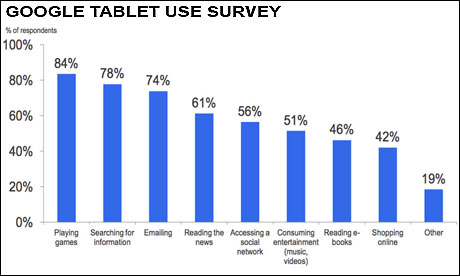
Research finds that 84% of tablet owners are playing games, versus 51% who are consuming music and videos.

A survey of more than 1,400 tablet owners in the US by Google's AdMob subsidiary has found that gaming is the most popular use for these devices, considerably ahead of music, video and ebooks.

According to the survey, 84% of tablet owners play games, ahead of even searching for information (78%), emailing (74%) and reading the news (61%). 56% of tablet owners use social networking services on their device, while 51% consume music and/or videos, and 46% read ebooks.

AdMob does not break out which tablets were owned by the users, but the survey was conducted in March this year, at a point when Apple's iPad accounted for the lion's share of the tablet market in the US – although Samsung's Galaxy Tab had also been available for a few months.

The survey found that 38% of respondents spend more than two hours a day using their tablets, while another 30% spend 1-2 hours. It appears that tablets are predominantly domestic devices, with 82% of people primarily using their tablets at home, versus 11% who say they are used primarily on the go, and 7% who said at work.

28% of respondents say their tablet is now their primary computer, while 43% say they spend more time using their tablet than they do their desktop or laptop computer.

It's the games stat that provides the biggest surprise though. It's not shocking that games are popular on tablets: the App Store charts for iPad apps make that crystal clear already. However, this is the first survey where games have come ahead of email as a usage for tablets.

What's missing from Google's survey, though, is data on time spent doing these various activities – for example, comparing the proportion of heavy tablet gamers with heavy emailers.

Tablet survey

Full AdMob report can be downloaded from here.

Posted via email from Technobedouin
Amazon Cloud Player steals march on Apple and Google

Amazon-cloud-player-005
Online retailer surprises rivals with launch of music streaming service and Cloud Drive 'digital locker'

Amazon has unveiled its ambitious music streaming service, Cloud Player, which allows users to play songs across a number of computers and Android smartphones.

Music lovers will be able to upload most of their existing music library – including tracks bought through Apple's iTunes – to Amazon, as well as buy new songs for digital playback.

The online retailer has stolen a march on rivals Apple and Google with the service, known as Amazon Cloud Player, with both internet giants planning their own forays into music streaming. The move also represents Amazon's repositioning as an entertainment destination, rather than just an online marketplace.

Another element of the service, Amazon Cloud Drive, works like a "digital music locker" where users can upload thousands of songs and listen to them via Cloud Player on any computer or Android smartphone.

"Our customers have told us they don't want to download music to their work computers or phones because they find it hard to move music around to different devices," said the Amazon vice-president of music and movies, Bill Carr. "Now, whether at work, home, or on the go, customers can buy music from Amazon MP3, store it in the cloud and play it anywhere."

As an introductory offer, Cloud Player is free to Amazon account holders, although users can pay to increase the amount of music able to be stored on Cloud Drive. Customers start with 5GB of storage space – equivalent to just over 1,000 songs – and those who buy an MP3 album from the Amazon store will be upgraded to the larger 20GB service.

Apple and Google are said to be planning similar ventures, while Sony's Music Unlimited also offers a digital music locker, but charges upwards of £4 a month. Agreements with all four major record labels are thought to be the sticking point for Apple's and Google's streaming services, with rights owners apparently unhappy with the idea of a one-off payment each time a track is played on any device.

Beyond Oblivion, an online music site partly owned by Rupert Murdoch's News Corporation, is proposing to woo rights holders by paying them a royalty each time their music is played. The service, which secured $77m (£47m) on investment earlier this month, is yet to launch and negotiations with music labels said to be at a "very advanced stage".

Amazon said it has sidestepped legal uncertainties about allowing users to upload music from their computer – some of which may have been downloaded illegally – by being the equivalent of any other storage device, such as an external hard drive.

The Amazon director of music, Craig Pape, said: "We don't need a licence to store music. The functionality is the same as an external hard drive."

• Amazon's online retail rival eBay yesterday stepped up its attempt to become the primary destination for internet shopping by buying GSI Commerce, an online services firm, for $2.4bn. The acquisition will allow eBay to expand beyond its network of small retailers into the larger retail market.

Source: Guardian Tech

sent from my Nexus S

Posted via email from Technobedouin
Tuesday, April 05, 2011

CONTROVERSIAL Wiki Leaks - American view on Greek media

media.pdf Download this file
ID : 71198
RefID : 06ATHENS1805
Date : 13/7/2006 6:50:00 πμ
Origin : Embassy Athens
Classification : UNCLASSIFIED//FOR OFFICIAL USE ONLY

SUBJECT: HOW TO READ THE GREEK PRESS: A GUIDE FOR THE UNINITIATED

ATHENS 00001805 001.3 OF 003ENTIRE TEXT IS SENSITIVE BUT UNCLASSIFIED - PLEASE HANDLE ACCORDINGLY

1. (SBU) SUMMARY. At first glance, the Greek media may resemble the media in the U.S., with a mixture of broadsheets and tabloids, national and local television and radio stations, and constitutional guarantees guarding the freedom of the press. Closer inspection reveals a Greek media industry controlled by business tycoons whose other successful businesses enable them to subsidize their loss-making media operations. These media operations in turn enable them to exercise political and economic influence. The result is that the media often provides an image of national and international events that is almost uniform but for its division along party events that is almost uniform but for its division along party lines. Similarly, a uniform anti-Americanism is injected into nearly every issue, but has little effect on the bilateral relationship. END SUMMARY.

The History of the Greek Media, from Homer to the Home Page

2. Homer reported on the Trojan War a few hundred years after it happened, and used the facts of the war to create a poetic tale of battles among gods, with men as pawns. Current Greek media uses the same blend of fact and fiction, with an equally judicious dose of deus ex machina (outside forces) that controls events. The first modern day Greek-language newspapers were established in Vienna and Paris in the 18th century and were an important factor in the Greek fight for independence from the Ottomans. With the founding of the modern Greek state, the tradition was established of blaming an outside power (first the Great Powers and then the U.S.) for all ills that befell Greece.

3. Greece currently has about 160 newspapers, 180 television stations, 800 radio stations, 3,500 magazines, and just 10 million people. (Portugal, with the same population, has 35 newspapers, 62 television stations, and 221 radio stations, according to the "World Factbook" of 2004). How can all these media outlets operate profitably? They don´t. They are subsidized by their owners who, while they would welcome any income from media sales, use the media primarily to exercise political and economic influence, and therefore care marginally less about turning a profit from their media operations. Because there are no subscriptions or home deliveries in Greece, newspapers have to sell themselves from newsstands by grabbing the attention of the casual passerby. This means that even the occasional calm and partially accurate story will have a misleading or untrue headline that often has nothing to do with the story. Still, the media utilize sensationalist headlines and stories to capture readers and the all-important television ratings that determine the distribution of advertising revenue. Newspapers also use such tools as DVD and book giveaways.

READ MORE OF THIS VERY INTERSTING & FRANK INSIGHT INTO A MEDIA WORLD by downloading the PDF attached..

Posted via email from Technobedouin